Applied mathematics, Sarajevo
SelmaSkopljakovićHubljar
I study how emotions move through a conversation. I write each conversation as a Markov chain and describe it by the spectrum of its transition matrix. Then I measure what changes when the speech is cloned.
- PhD researcher
- Doctoral Study of Mathematical Sciences in Southeast Europe
- Faculty of Science, University of Sarajevo
Research
Markov chains and spectral graph theory, applied to speech and emotion.
What I work on
-
The chain
A conversation has an order. Someone is calm, someone gets angry, and something follows. I write that order down as a Markov chain over emotions, one chain for each conversation.
-
The spectrum
The chain is a matrix, and a matrix has a spectrum. From its eigenvalues I compute a small set of indices. Spectral graph theory uses indices of this kind to describe graphs and molecules. Here they describe how emotion moves through a dialogue.
-
The clone
Cloned speech can sound like the person it copies. I measure whether it also keeps the order of emotions the real conversation had, and I compare those measurements with detectors of cloned speech.
Papers
Preprints and manuscripts. Links appear when a paper is public.
Papers
-
In preparation
Paper 1
A conversation is written as a Markov chain over emotions. Indices computed from the spectrum of its transition matrix describe how emotion moves, in real speech and in cloned speech.
-
In preparation
Paper 2
Measurements of emotion dynamics are compared with detectors of cloned speech.
-
arXiv, 2026
SHAP-Weighted Cross-Modal Expert Fusion for Emotion and Sentiment Recognition: Evidence and Limits
Separate experts for text, speech and face are fused with weights taken from SHAP attributions. Tested on MELD and CMU-MOSEI.
A. Alihodzic, S. Skopljakovic Hubljar. arXiv:2607.08573
App
On iPhone, on Android and in the browser.
EmpaThink
An app that reads emotion from text, speech and face, and shows why it read it that way.
Every result comes with a button that asks “Why this emotion?”, and the app answers.
Visuals
Animations drawn from measured numbers. Made for the phone screen and for Instagram.
Mathematics you can watch
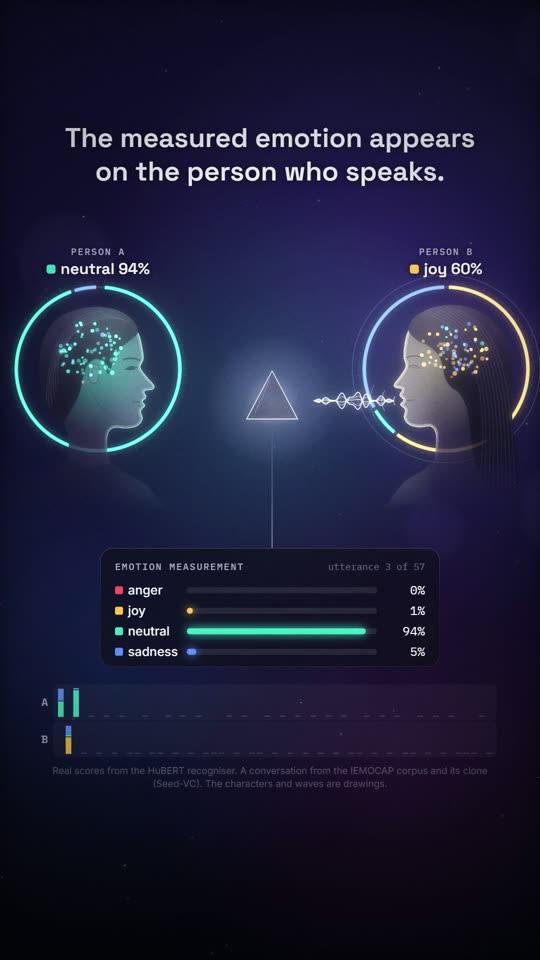
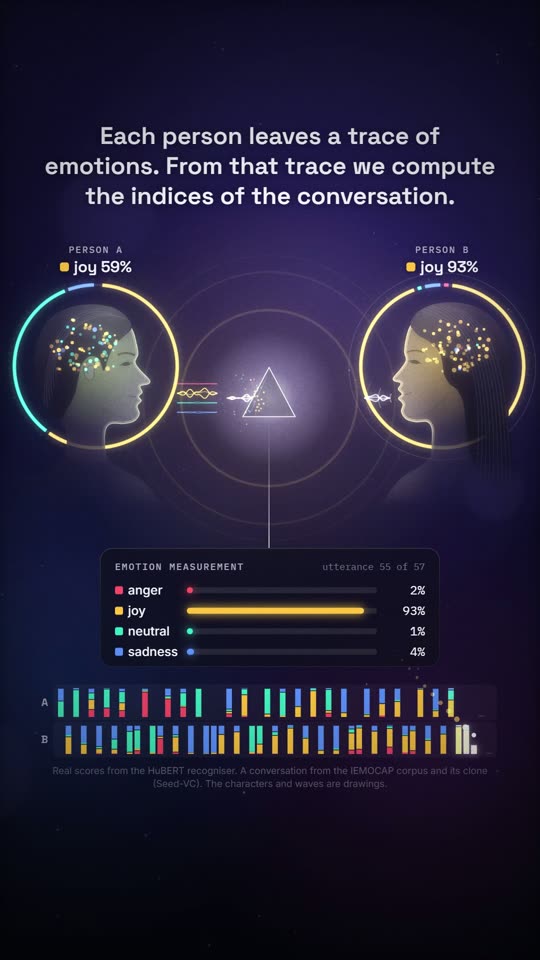
Film, 39 seconds
Waves and Emotions
Two drawn speakers and real measurements. The emotion measured in each utterance appears on the person who speaks, and every speaker leaves a trace.
Interactive
Emotion flow in a conversation
One conversation of 57 utterances, played turn by turn, next to its clone.
Life
What I do when the laptop is closed.
Outside the matrix
Four seconds in, six out
Yoga
Notes and photos from the mat will live here.
Contact
Say hello
- ORCID0009-0000-3926-6031
- arXivarXiv:2607.08573
- Instagram@selex_engineering_phd